Long before Jaipur became a destination on postcards and travel itineraries, before its palaces were photographed and its markets mapped onto guidebooks, there was cloth.
Not the finished garment, nor the neatly folded fabric on a shelf, but cloth stretched beneath the Rajasthan sun. Cloth being washed in river water. Cloth laid out to dry on dusty banks. Cloth waiting patiently for colour.
The story of block printing in Rajasthan begins there.
For centuries, communities of printers, dyers, and craftsmen moved across western India carrying with them knowledge that could not be written down easily. It lived in the hand, in the eye, in the memory of a family. Among them were the Chhipas, whose name comes from the Hindi word chhaap — to print. They settled around Jaipur, particularly in Sanganer and Bagru, where the craft would evolve into one of India’s most celebrated textile traditions.
In Sanganer, near Jaipur, printers found ideal conditions: clean water, open land, and royal patronage. Delicate floral patterns emerged here, inspired by Mughal gardens, trailing vines, flowering trees, and the geometry of nature itself. By the eighteenth century, Sanganeri prints had become sought after far beyond Rajasthan, travelling across trade routes and eventually finding their way into European markets.
Bagru told a different story.
The colours were deeper. Earthier. Less concerned with refinement and more connected to the landscape itself. Here, artisans worked with indigo, iron black, madder red, pomegranate, turmeric, and mud-resist techniques known as Dabu. The palette seemed borrowed directly from the desert after rain — clay, bark, stone, dust, and sky.
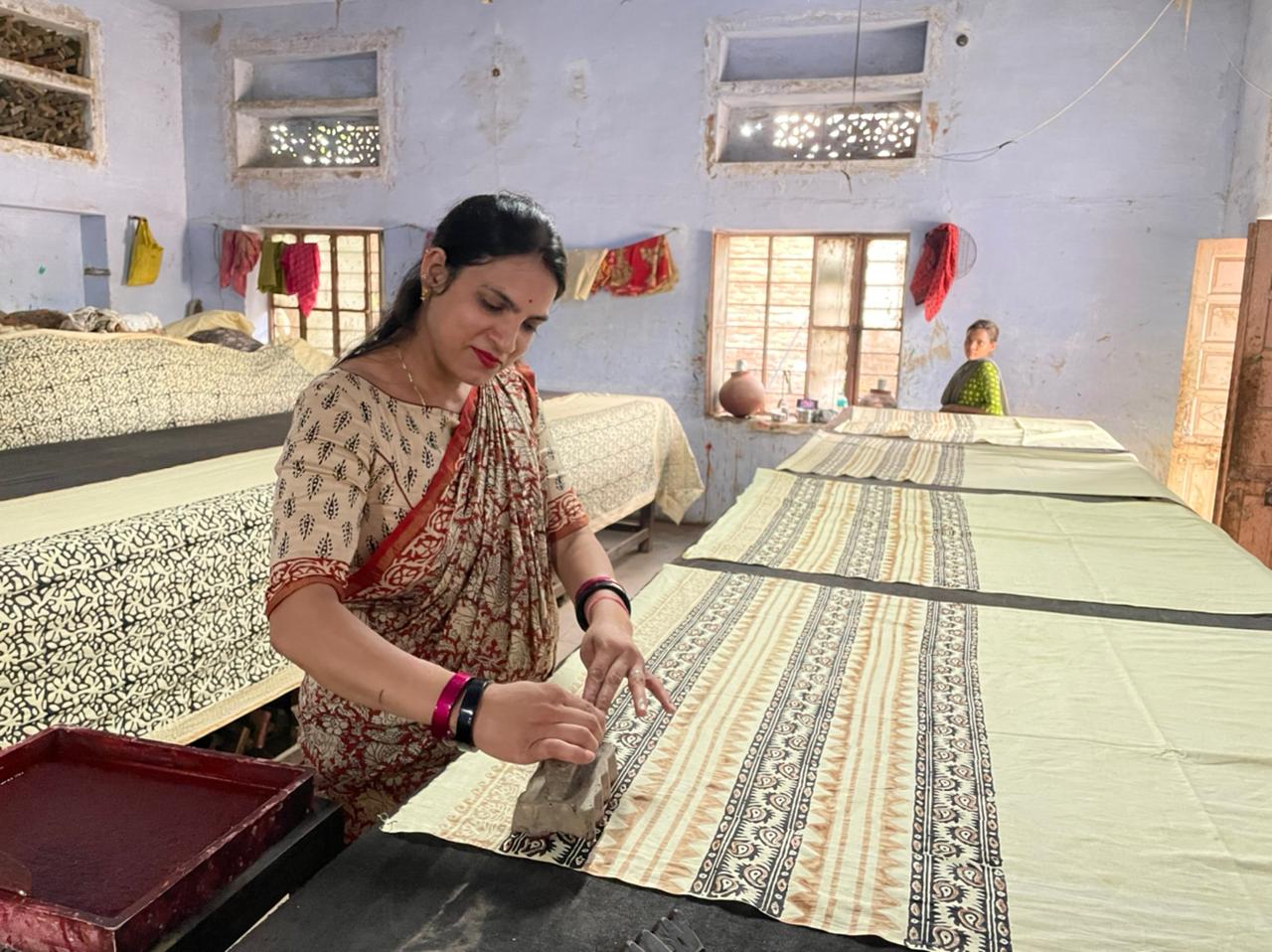
A wooden block might take days to carve. A single motif could require several blocks: one for the outline, another for colour, another for detail. The printer’s hand had to return to exactly the right place, again and again, until the pattern revealed itself across metres of fabric.
These textiles became part of everyday life in Rajasthan. Women wore flowing ghagras and odhanis printed with flowers, vines, and repeating motifs. Men wrapped long turbans whose colours carried stories of region, season, and identity. Cloth was never merely decorative; it belonged to the rhythms of daily life, to festivals, marriages, journeys, and work. It absorbed memory.
Today the craft is known around the world as hand block printing, woodblock printing, or simply block print. Yet those names only describe the technique. They do not describe the sound of a carved block striking cotton. They do not describe rows of printed fabric drying beneath a Rajasthan sky. They do not describe the generations of artisans who learned to judge colour by sight and weather by instinct.
Perhaps that is why block printing continues to endure.
Not because it is old, but because it remains human.
Every slight variation in colour. Every imperfect alignment. Every trace left by the hand rather than the machine. These are not flaws. They are evidence that somebody stood here before us and made something carefully.
At Indus Route, we carry that story forward in our own way. Not as preservation behind glass, but as living craftsmanship — transformed into pieces designed for modern life while remaining connected to the traditions from which they came.


Leave a Reply